Case Studies · 9 min read
The Rise of the iGaming "Newspaper": How One Affiliate Cracked Sweden in 12 Months

More and more affiliates are launching websites that look more like newspapers than traditional affiliate sites. One Swedish project shows how far the model can go in just 12 months.
If you have followed iGaming SEO over the last two years, you have probably noticed a trend: more and more affiliates are launching websites that, at first glance, look more like newspapers than traditional affiliate sites.
The trend really started gaining momentum when it became known that ClickOut Media had acquired GamblingInsider.com and CasinoBeats.com.
Before this, we had already seen what the SEO industry liked to call "parasite SEO". The principle was somewhat similar, except that the websites being used often had very little to do with gambling.
One of the more extreme examples was a Nigerian news website ranking #1 for highly competitive casino-related searches in Australia and New Zealand.
When the Gambling Insider and CasinoBeats acquisitions happened, it wasn't particularly difficult to put one and one together.
Then came NEXT.io and its rather extraordinary growth in the US sweepstakes casino market.
In practice, affiliates had started combining authority, credibility and topical relevance with some of the principles that had made parasite SEO so effective.
Calling this "parasite SEO" isn't entirely fair, though.
If a publication already covers the gambling industry, is it really that strange for it to also provide information aimed at players?
There is also a fairly obvious commercial reason for doing it. Running an iGaming B2B publication isn't necessarily the most lucrative business in the world. Adding B2C affiliate revenue can completely change the economics.
The iGaming media gold rush
The success of this model created something of a hype cycle.
Suddenly, established iGaming news websites became attractive acquisition targets. At the same time, a completely new category of websites started appearing.
I ended up on the other side of this somewhat unintentionally.
We established iGamingToday.com before this wave really took off, and over time we received quite a few acquisition approaches --- some serious, some considerably less serious.
The reported numbers surrounding GamblingInsider.com also helped establish something resembling a benchmark for what these types of properties could potentially be worth.
The result?
Instead of acquiring an established publication, many operators and affiliates simply started building their own.
And that is partly why we now have every possible variation of "iGaming this" and "iGaming that".
The problem is that breaking through has become significantly harder.
You need to compete for attention within the industry, establish a credible media brand and, eventually, compete organically against websites that may have years of history behind them.
There are, however, some remarkable success stories.
And those are the ones worth studying.
What happens when you take the media model local?
Replicating the results of websites such as NEXT.io or Gambling Insider is impressive enough.
Replicating their history is another matter.
You can't simply recreate five or ten years of authority overnight.
But what happens if you take the same general concept and apply it to a smaller local market?
Someone in Sweden appears to have done exactly that.
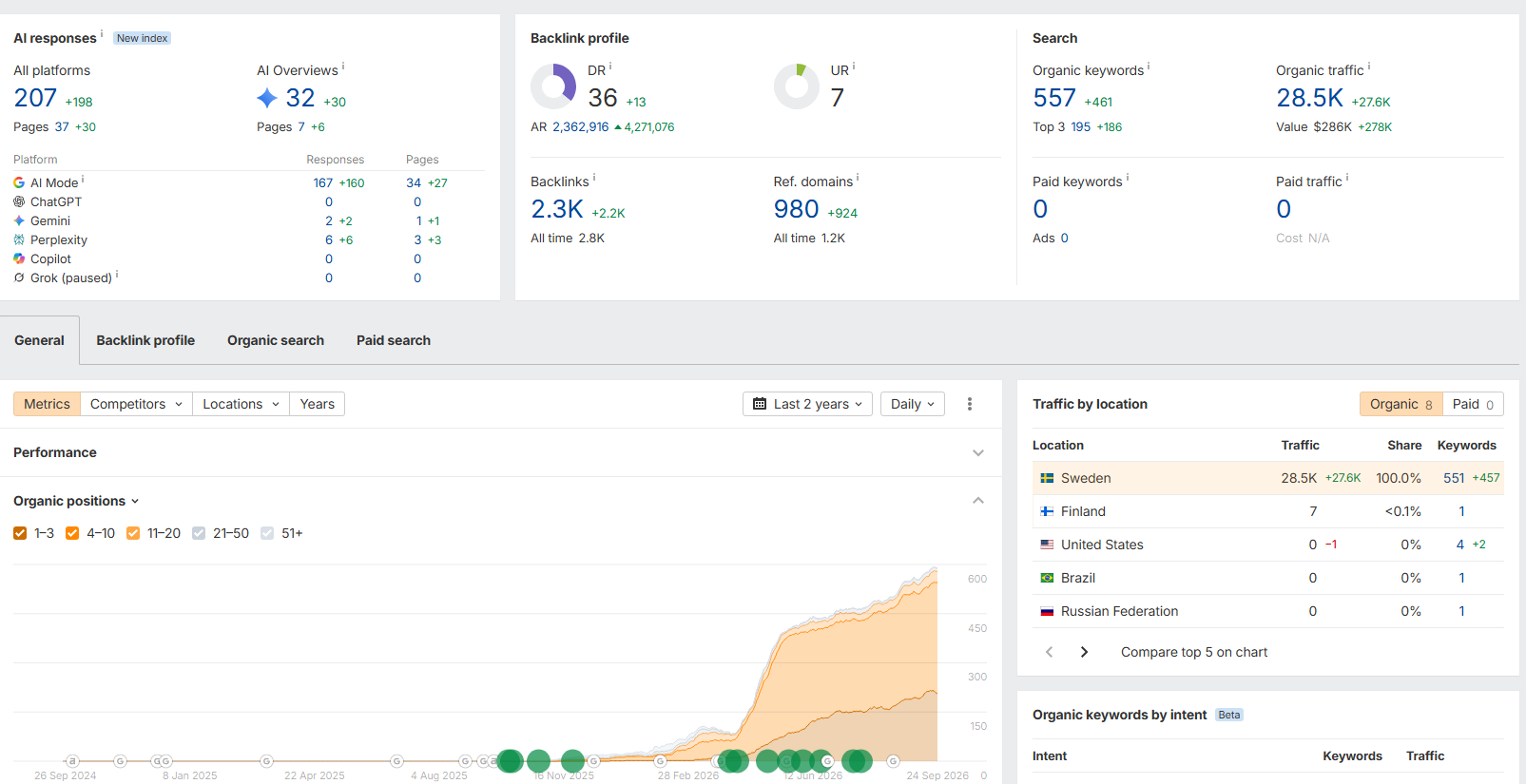
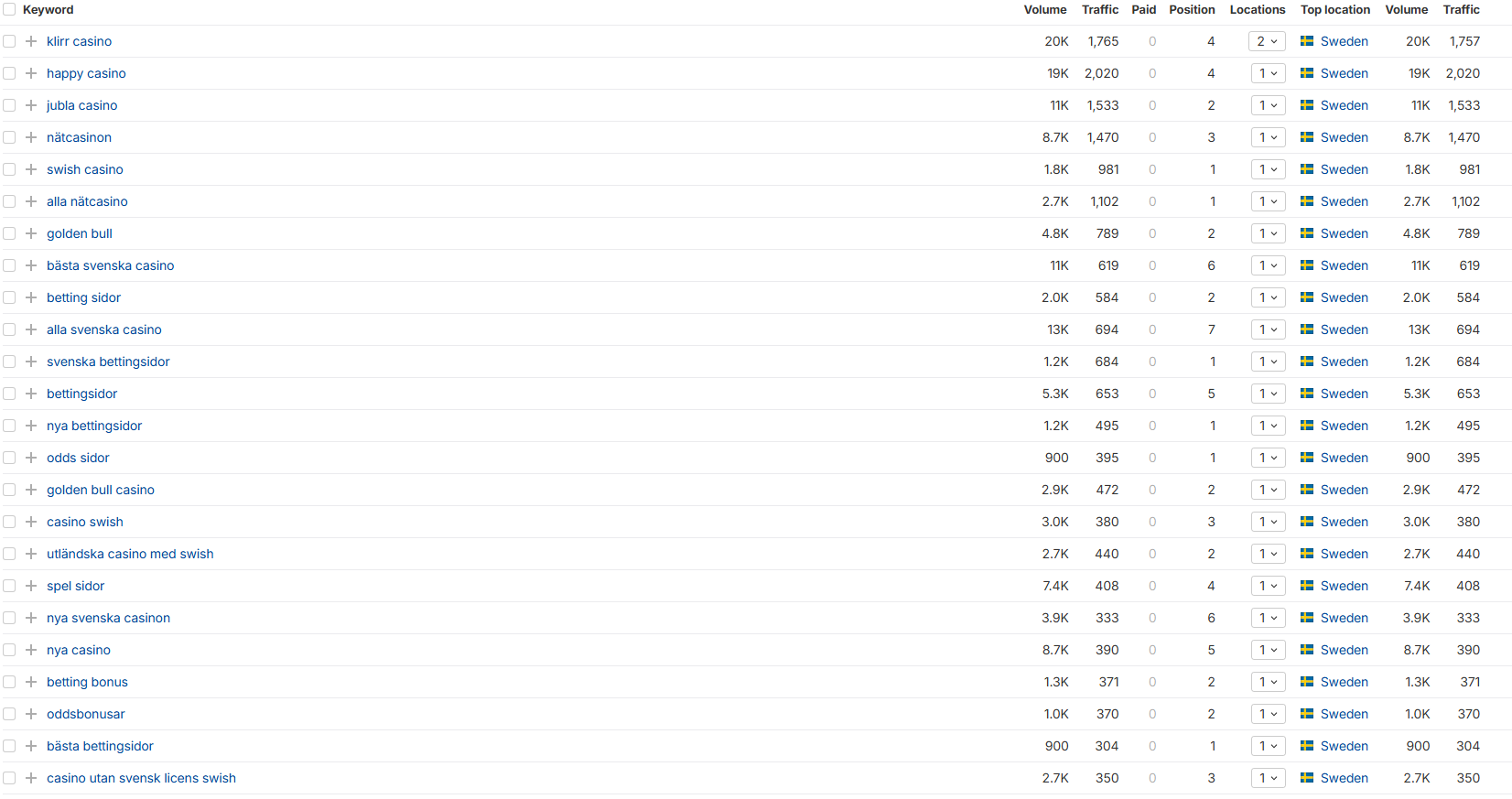
In roughly 12 months, a relatively new website has managed to reach top positions for keywords that would normally take affiliates years to compete for.
What makes the case particularly interesting is that they appear to have built a hybrid.
The website looks and operates like a media publication, while the link-building strategy has more in common with the kind of affiliate SEO we saw working extremely well around 2022 and 2023.
That combination makes this an interesting case study.
We have deliberately chosen not to reveal the domain. The purpose of this case isn't to send hundreds of SEO people towards one website or create unnecessary problems for its owners.
We're interested in what we can learn from it.
The screenshots below show the development according to Ahrefs.
As always, these numbers should be treated as estimates. Actual traffic may be significantly higher or lower.
Licensed or unlicensed?
Sweden has a relatively strict gambling licensing regime.
This website exclusively promotes licensed operators.
Whether Google can reliably understand or reward that distinction is another question entirely, and we don't have evidence to claim that licensing itself explains the site's performance.
Still, it is worth noting as part of the overall picture.
The site isn't using the media model as a disguise for aggressively promoting offshore casinos. Its commercial content is aligned with the regulated Swedish market.
What technology are they using?
When we first started analysing the project, we expected to find some kind of sophisticated technical setup.
Maybe there was some "ninja shit" going on behind the scenes.
There wasn't.
The website runs on WordPress using JNews.
Yes, JNews --- basically one of the first themes you will encounter if you search for a WordPress news theme on ThemeForest.
The website is extremely fast, so there has clearly been attention paid to performance. They may be using JNews' faster performance options, additional optimisation, better infrastructure or a combination of all three.
But fundamentally, there is nothing particularly exotic about the setup.
From a purely technical perspective, almost anyone could replicate it.

And that is arguably one of the most interesting parts of the case.
There doesn't appear to be some magical proprietary CMS or complicated technical SEO architecture responsible for the growth.
Publishing frequency
The website currently publishes approximately 3--5 news articles per day across several categories.
A significant proportion of the coverage is related specifically to Sweden, while the site also publishes selected international stories.
The publishing frequency appears to have been lower during the site's early months and increased as the website gained traction.
This is an important distinction.
They didn't simply launch hundreds of articles and wait for Google to figure things out.
The site appears to have gradually increased its output as the domain grew.
AI content or human-written?
We analysed a selection of the site's content and found no obvious indications that the articles were being generated entirely by AI.
That doesn't mean AI isn't involved.
It could easily be used for research, structure, editing or parts of the production workflow.
However, the articles regularly contain references, dates and contextual details that suggest there are actual writers involved in the publishing process.
The website currently lists four contributors, with two authors responsible for the majority of published content.
The important point isn't necessarily whether AI touches the content somewhere in the workflow.
It is that the finished product looks like editorial content rather than mass-produced affiliate copy.
The link strategy
This is where things become particularly interesting.
When looking at some of the other iGaming media sites that have moved into affiliate, you can sometimes get the impression that the strategy is:
Build the publication organically → establish authority → launch affiliate content → start building commercial links.
This website appears to have taken a different approach.
The earliest article we were able to find was published on September 27, 2025, meaning the website is now approaching its first anniversary.
Some links appear to have been built relatively early.
The initial links we found weren't particularly impressive and looked relatively low quality. Over time, however, the quality of the referring domains appears to have improved considerably.
The domain has now reached approximately DR 36 according to Ahrefs.
As always, separating paid links from naturally acquired links is difficult from the outside.
Recently, however, there appears to have been a particular focus on acquiring links from Swedish news and media websites rather than gambling-specific publications.
Some of these articles are explicitly labelled as advertisements.
Others are less obvious.
Based on placement, context and anchor-text patterns, it seems reasonable to suspect that at least some of these links were commercially acquired --- although without access to the transactions themselves, we obviously can't know this with certainty.
What is notable is that the anchor-text profile doesn't appear particularly aggressive.
There is considerable variation, and the strategy doesn't look like an attempt to hammer exact-match commercial anchors at the domain.
The really interesting part
None of the individual components are particularly revolutionary.
WordPress?
Nothing special.
JNews?
Anyone can buy it.
Three to five articles per day?
Completely achievable.
DR 36?
Good for a young website, but hardly unheard of in gambling SEO.
Paid links?
Welcome to iGaming.
Yet when you combine these relatively ordinary ingredients, the result is anything but ordinary.
Within approximately one year, the website has managed to compete with --- and in some cases outrank --- affiliates with significantly older domains and stronger link profiles.
That is what makes this case worth paying attention to.
Can they maintain the growth?
This is now the big question.
Rapid SEO growth is interesting.
Maintaining it through multiple Google updates is much more interesting.
The site has been very open about operating both B2B editorial content and B2C commercial content. There isn't much attempt to hide what the business model is.
If there is one obvious question mark in the strategy, it is the link acquisition.
Several links appear commercially acquired, and some are explicitly labelled as advertising. Whether that eventually becomes a problem --- or simply continues to work --- is one of the things that makes this website worth tracking.
We intend to revisit the case periodically and, in particular, after major Google updates.
Rather than pretending we know whether this growth is sustainable, we would rather watch what actually happens.
A blueprint for other markets?
This is ultimately why we find the case so interesting.
The "media affiliate" model has largely been associated with large international websites.
At the same time, another trend has been developing in the SERPs: large global websites have increasingly competed with what we traditionally called the "local heroes".
This Swedish website may have flipped that dynamic around.
Instead of trying to build another traditional Swedish casino affiliate, they appear to have taken the concept used by large international media brands and localised it.
That might be the real insight here.
Take the global iGaming media model and build it locally.

Based purely on the relationship between publishing output and organic results, the performance so far is impressive.
Yes, money has clearly been invested into links.
But the links we identified aren't necessarily the kind of placements that require an extraordinary budget.
More importantly, the website is outranking several affiliates with older domains, more referring domains and stronger overall backlink profiles.
That suggests that simply looking at DR and backlink counts doesn't explain what is happening.
The media positioning, publishing frequency, topical relevance, local focus, link profile and commercial architecture may be working together in a way that Google currently responds very well to.
The question is how much each component matters.
We'll keep watching
For now, there are more questions than answers.
Did they simply launch the right type of website at exactly the right time?
Did they get lucky?
Is there a "secret sauce" somewhere that we haven't identified?
Does operating exclusively in the licensed Swedish market matter?
Is the publishing frequency creating topical signals that traditional affiliates struggle to replicate?
Are links from mainstream Swedish media more valuable in this context than stronger links from gambling-specific websites?
Or is this simply another signal of how Google currently evaluates iGaming websites?
We don't know yet.
And that's exactly why this case is interesting.
We'll periodically update the key Ahrefs metrics and revisit the site after major Google updates. If the website is still sitting at the top of these SERPs a year from now, we'll have learned considerably more than we know today.
For now, though, one thing is clear:
You don't necessarily need ten years of domain history to build something that looks like a ten-year-old authority.