Brazil’s betting ban, seven weeks in: half the searches, and government pages in the top 10

Seven weeks into Brazil's betting ban: what happened to search demand, who ranks now, and why a lower bar to rank is not an opening.
By Milan Novaković 8 min read
Brazil banned online betting on 25 September. Seven weeks later, Congress hasn’t voted on the ban, its deadline has moved to 4 March 2027, and the bill that would make promoting betting a crime has blocked the Chamber’s agenda since 13 November. I wanted to know what the ban did to Google. Searches for “bet” halved and stayed there. The licensed sites left the top 10. And in mid-November, pages on government servers took up to a third of it.
Where the ban stands
Provisional Measure 1.394 is still in force. On 11 November Congress extended it by 60 days, and the Congress page now gives 4 March 2027 as the last day to turn it into law. The joint committee that has to review it was named on 30 September and still hasn’t been set up. It has no chair and no rapporteur, and none of the 99 amendments has been voted on.
The crimes bill sent with the measure, PL 5.477/2026, has blocked the Chamber of Deputies’ voting agenda since 13 November, when its 45-day urgency window ran out. It hasn’t been sent to a committee yet. As written, it would punish operating betting with 4 to 6 years in prison, even with a foreign license, and promoting betting or referring bettors with 2 to 4 years. The promotion penalty would rise by half when the pay is a fee, a commission or a share of bets or losses tied to signing up bettors. That describes both CPA and revenue-share deals.
At the Supreme Court, Justice Luiz Fux held a public hearing on 3 November. On 8 November he suspended every court case in Brazil that challenges the measure until the court rules. The full court still has to confirm that order, and four challenges are pending.
The sports-only compromise NEXT.io reported on 13 November rests on amendments, not a deal. Senator Dr. Hiran’s Amendment 38 would allow bets on real sports events and keep online casino banned, with advertising limited to a logo on match shirts and radio and TV spots with no people, avatars or synthetic voices. It wouldn’t bring back the licenses. Senator Marcos Pontes’s Amendment 15 would keep sports betting under the 2023 law and ban ads that use influencers, tipsters or affiliates. Neither has been voted on.
Enforcement runs alongside. By 9 November the Justice Ministry’s monitoring had counted more than 60,000 sites, pages, profiles, groups and servers promoting illegal betting since the ban, 51,611 of them websites.
Brazilians search for betting half as much
Google Trends gives a daily index of search interest, where 100 is the busiest day in the period. Interest in “bet”, the word Brazilians use for betting sites, averaged 41 from 1 August to 24 September. It hit 100 on 26 September, the day after the measure was published. Since 6 October, the first day without licensed sites, it has averaged 20.
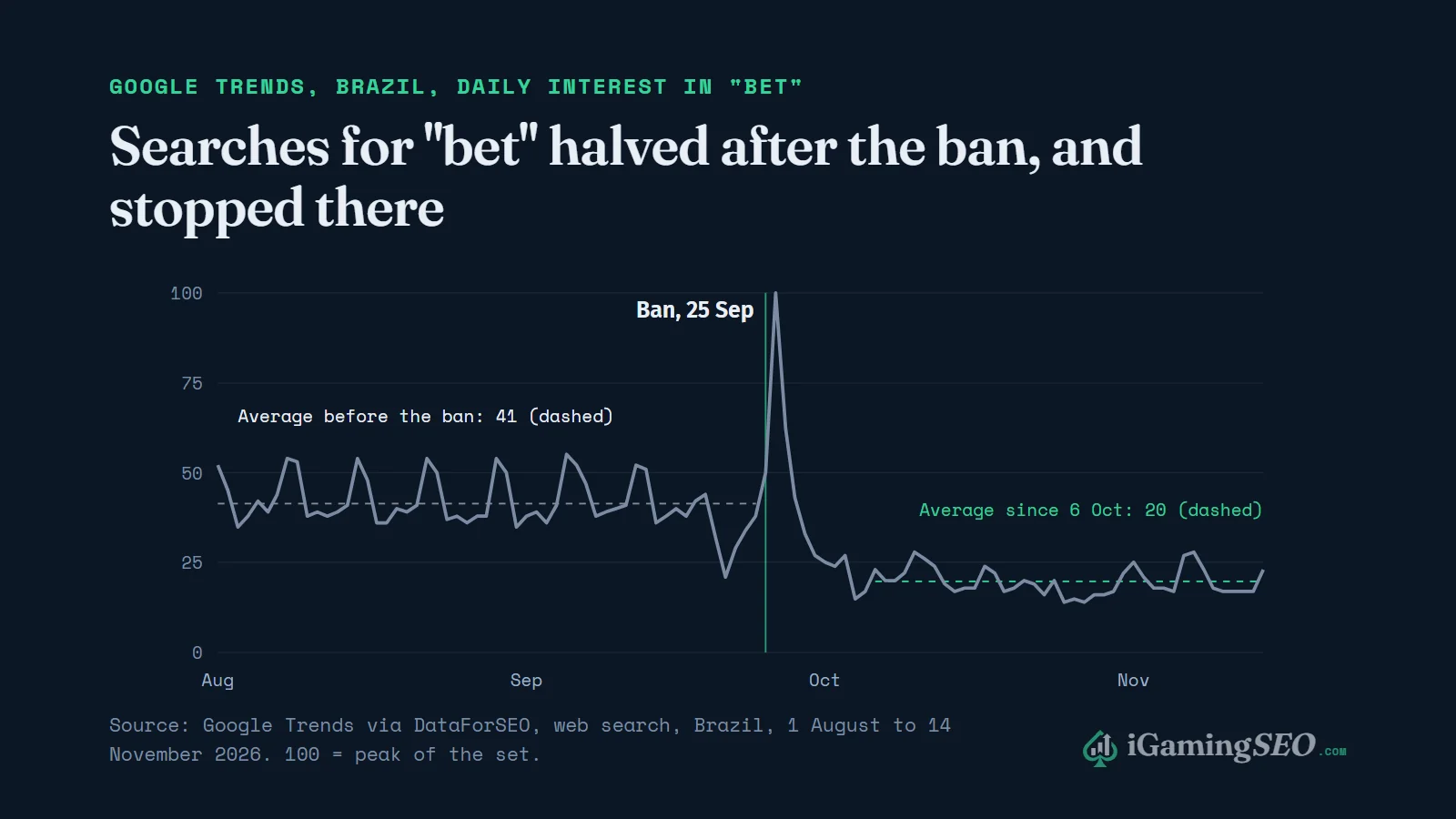
“Cassino” fell by about the same share, 44%. “Apostas”, the plain word for bets, stayed flat. So the ban cut demand in half. It didn’t remove it. Half of the old interest is still there every day, six weeks in, and somebody answers those searches.
Who answers those searches now
Our volatility score checks 25 Portuguese casino and betting searches in Brazil every night, twice each. To see the results before the ban, I pulled DataForSEO’s stored snapshots of the same searches. In the latest snapshots before 25 September, taken between July and mid-September, licensed .bet.br sites held 23 of 195 positions across 22 searches, and they ranked first in four. On 15 November, they held 4 of 351.
Their places went to whoever was left. Take “cassino online”. On 6 September its top 10 had two licensed casinos, four Brazilian news and sports sites with casino rankings, an app store listing, a review site and an operator’s international site. On 10 November it had no licensed casino at all. It showed an app store listing for a free slots game, two operators’ international sites, a game studio, one news site’s casino ranking, a marketplace listing that sells casino website scripts, a YouTube video, a review site and a web portal’s free games page.
Government pages at the top
Then it got stranger. Our overnight check on 15 November found pages on government subdomains, the .gov.br addresses of city halls, councils and federal bodies, in 105 of the 351 positions. They appeared in 25 of the 50 result lists and ranked first in 22 of them.
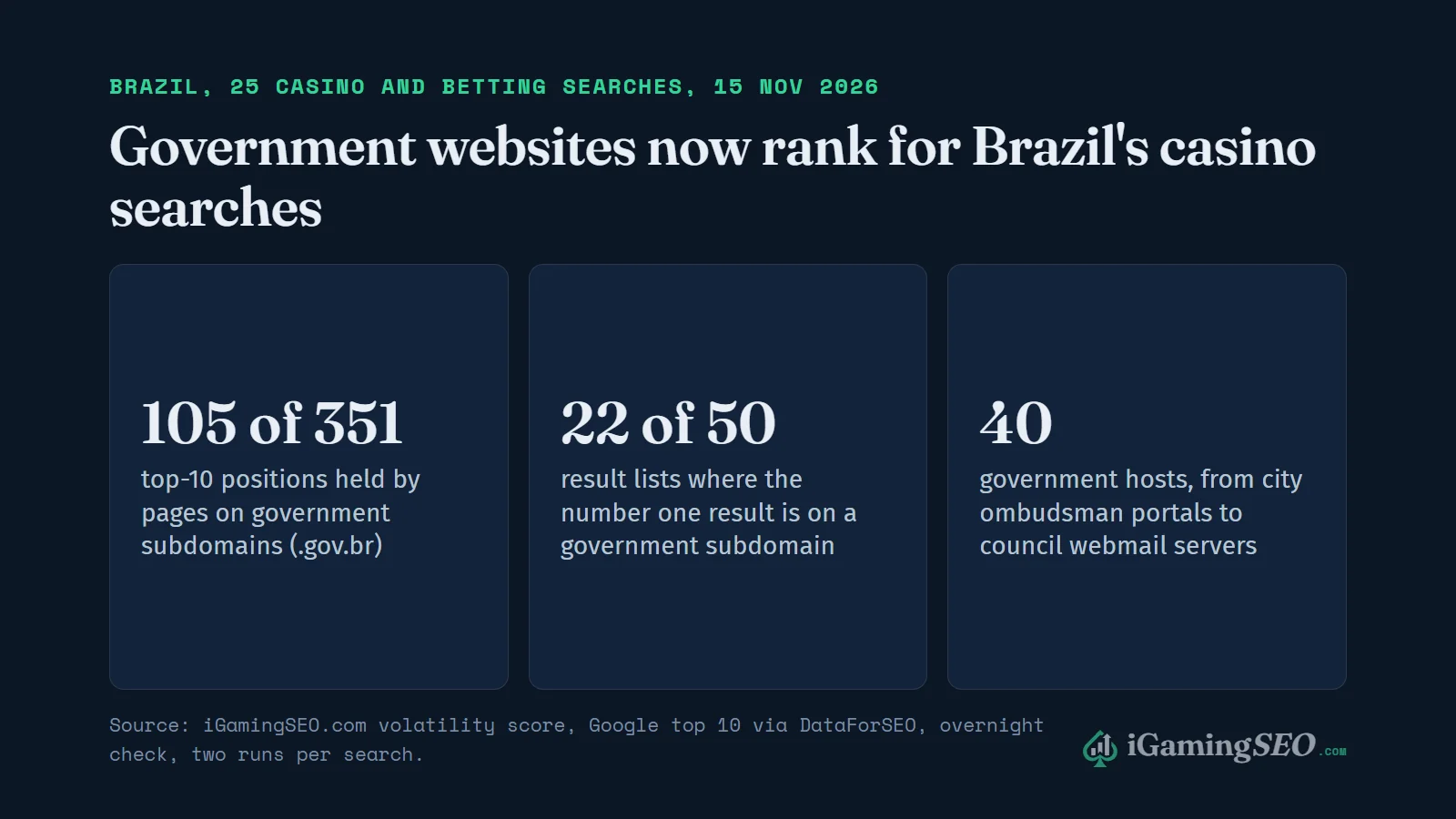
The 40 hosts in that sample include a city ombudsman’s portal, the webmail servers of a dozen city councils, Health Ministry systems, state cloud and file servers and a weather alert service. None of them has anything to do with betting.
Our score picked it up before I did. Brazil’s reading stayed at 0.62 or lower on most days in November. It jumped to 1.19 on 12 November, 1.37 on 13 November and 2.02 on 14 November, and read 1.38 on 15 November.
Ahrefs shows how fast one of these hosts grew. The ombudsman’s portal ranked for 15 queries in Brazil on 14 September, with an estimated 77 visits a month. On 14 November it ranked for 899, 159 of them in the top three, with an estimated 51,184 visits. It was first in Google for the names of several betting brands, and it ranked for lottery and jogo do bicho results, adult searches and torrent sites.
They were still there in the afternoon. At 12:51 UTC on 15 November, a live check of all 25 searches found government pages in 43 of 182 positions, first in 10 searches. In “site de apostas”, all nine results were on government subdomains. Of the 43, 41 had no description in the results, just the raw address as the title and Google’s “Saiba o motivo” link, the note it shows when it has no information about a page.
The odd part is that they don’t show up every time. A live check of three of the same searches, minutes earlier, found none, so the same search returned two different top 10s. DataForSEO’s stored snapshots from 10 to 14 November don’t show them either. What you see depends on when you ask.
I’m not naming the hosts, and I’m not saying how the pages got there. That is for the public bodies that run them to find out. What the data shows is the part that matters for SEO: when the strongest sites leave a market, pages on servers that have nothing to do with betting can reach first place.
One caveat on all of this. Google Trends is a relative index, not a count of searches. DataForSEO’s stored snapshots come on irregular dates, and they missed the government pages that our overnight check, the afternoon check and Ahrefs all recorded. The results also differ from one request to the next. Ahrefs traffic is an estimate. Treat the numbers as a sample of 25 searches, not a market study.
Is the barrier lower now?
My first read of the ban was this. It doesn’t end betting in Brazil, it moves it to the unregulated market. The licensed operators paid for licenses, ran on .bet.br domains, checked every bettor’s identity and spent the most on content and links. They’re gone from the results, so for SEO people there is more work and a lower bar to entry, in rules and in money.
The ranking half of that is true. Government pages with no description at the top of Brazil’s betting searches prove it.
The business half is not, and this is where people get hurt. Provisional Measure 1.394 bans all content aimed at the Brazilian public that offers, promotes, publicizes or eases access to betting, whatever its format and however it is paid. It doesn’t mention affiliates, SEO or search engines by name. The ban turns on what the content does and who it is aimed at, not on how it is made or paid for. The bill would go further and make promoting betting, or referring bettors to it, a crime, with the heavier penalty for exactly the commission and revenue-share deals affiliates run on. The bill isn’t law yet. Work done for operators while their Brazilian license was valid would not be a crime under it. The opening in the results is real. Working it for betting aimed at Brazilians is against the measure in force today, and it may be a crime next year.
So yes, Brazil means more work for SEO people. Just not that work.
- Monitoring. Brazil’s results now change by the day. Publishers, the companies waiting for the market to reopen and anyone with a brand at stake need daily tracking, not a monthly report.
- Brand protection. Some searches for the names of betting brands now land on pages on government servers. A company that wants its name back needs someone to find those pages and report them to Google.
- Cleanup. One night’s sample turned up 40 government hosts. Each needs someone who can find the pages, remove them and ask Google to drop them.
- Publishing. The bill, as drafted, exempts journalistic, informative, educational, academic, scientific and critical content about betting. The measure in force has no such clause, so a publisher covering the ban for Brazilian readers needs its own lawyer’s read too.
- Getting ready. If either sports-only amendment passes, sports betting comes back under stricter rules than before, and Amendment 15 would ban ads that use affiliates. I expect the sites that kept their domains, their links and their content within the rules to be first back in the results.
My take
A ban doesn’t delete a search. It deletes the licensed answer, and Google fills the gap with whatever ranks: offshore sites, app stores, YouTube and, this November, pages on government servers. That is more work for SEO people, but it’s cleanup, protection and patience, not a land grab. If the empty top 10 looks like an opening to you, read Provisional Measure 1.394 before you do anything with it. I’ll run the same 25 searches again when Congress votes.
This article reports Brazilian rules and search data as of 15 November 2026. It is not legal advice, and it does not encourage anyone to gamble or to offer, promote or work for betting services aimed at Brazil.
Where this comes from
15 sources from 9 publishers
5 of them our own measurements. Links as read on November 15, 2026.
 iGamingSEO.com 5
 camara.leg.br 2
- legis.senado.gov.br 2
- in.gov.br
- congressonacional.leg.br
- +4 publishers
See the listHide the list
-
Google Trends via DataForSEO, Brazil, web search, daily, 1 August to 14 November 2026
-
DataForSEO stored Google snapshots, Brazil, 22 of 25 searches, latest before 25 September 2026
-
DataForSEO live Google top 10, Brazil, 25 searches, 15 November 2026, 12:51 UTC
-
Ahrefs Site Explorer, one municipal ombudsman subdomain, Brazil, 14 September and 14 November 2026