Linkbuilding · 9 min read
Can PR Turn Into Links in iGaming?
Whether you’re an affiliate, operator, or B2B supplier in iGaming, you know how important it is to be visible on Google, both in paid and organic search. And if you want to be visible organically, links (authority) still matter.
The difference compared to a few years ago is that it’s not necessarily about the number of links anymore, but the quality of those links.
Within iGaming, there are certain links I would define as “trophy links”:
- Links from major media outlets that have nothing to do with gambling
- Links from iGaming media with actual traffic
- Links from other iGaming companies with traffic and a strong link profile
There are plenty of ways to go after these links, and everyone makes different choices. Some buy links through marketplaces, some buy domains with existing links and redirect them, while others do massive amounts of outreach.
Then you have those who use PR to try to get links.
Those who actually master getting natural links through PR can save a lot of money while often getting some of the best links out there.
But it’s not easy.
When I was running iGamingToday.com, I probably read hundreds of press releases containing some form of “linkbait”. Some were sent directly to us, while others came through one of the many PR agencies working within iGaming.
I think I published maybe a handful of them.
Why?
Because I knew how much a link was worth within iGaming, while most of the press releases were extremely low effort. That also made it very easy to say yes on the rare occasions when someone had actually spent a few days working on something that provided real value.
That’s what makes iGaming a bit of a special case.
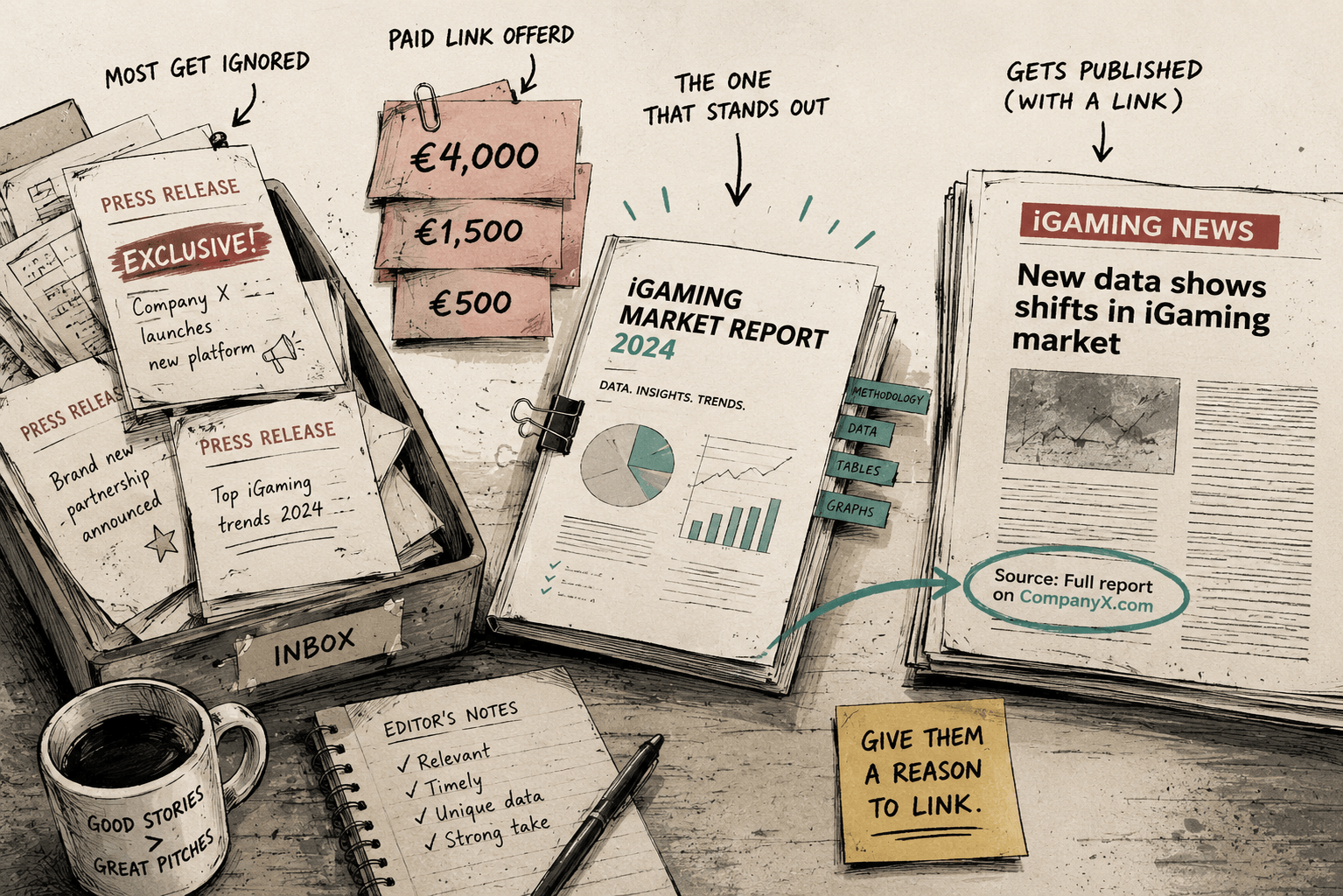
A lot of media outlets would rather avoid publishing articles with outgoing links to commercial companies. The reason is pretty simple: the market value of a link can be anywhere from €500 to €4,000.
And in the same inbox you’re sending your press release to, there are emails arriving every day from companies willing to pay for that exact same link.
So you need to give the publisher a pretty good reason to give it to you for free.
How do you do that? I have made a guide, its mostly meant if you want links from the “igaming media”. Getting links from mainstream, media is a different play and another kind of article.
1. Identify Where You Actually Want Links From
It can be tempting to want links from everyone and everywhere, but one size doesn’t fit all.
Start by identifying where you actually want links from.
Even though the different igaming medias is fairly similar, there are some differences in how they write and also what kind of content they have a appetite for.
This matters because whatever you’re going to create should be tailored to the publications you actually want to get into.
A story that works perfectly for an iGaming publication might not be a fit for another one.
2. Find Out What the Media Actually Cares About
I think a lot of people do this in the wrong order.
First, they create the press release. Then they start figuring out who to send it to.
I’d do the opposite.
Analyse the publications before you start producing anything. Some media outlets write extensively about regulation, others focus on responsible gambling, while others are more interested in case studies, companies, or hard numbers.
Read what they actually publish.
What kind of stories do they cover? What sources do they use? What data do they reference? And perhaps even more importantly if your goal is links: What do they actually link to?
You can get incredibly far simply by understanding the publication before you start creating anything.
3. Spend Time Creating Something That’s Actually Interesting
This is probably the most important point if you want to increase your chances of getting PR coverage.
You actually need to create something interesting.
“Company X launches Product Y” is rarely very interesting to anyone other than the people working at Company X.
Within iGaming, we actually have a pretty big advantage here because there are so many interesting angles and a real hunger for unique insights. To be honest, there is too little of that in igaming.
It could be data on markets, regulation, player behaviour, payment methods, responsible gambling, affiliates, M&A, or publicly listed gambling companies.
It doesn’t need to be the biggest study in the world either.
Sometimes, simply collecting data that already exists and presenting it in a way nobody else has done before can be enough.
Ask yourself:
Why should someone who doesn’t work for my company care about this?
If you don’t have a good answer, I’d spend more time on the idea before you start pitching it.
4. Create Something That’s Actually Natural to Link To
If all the information is already in the press release, why should the journalist link to your website?
That’s probably one of the most important questions you can ask yourself.
Give them a reason to link.
It could be a larger analysis, a dataset, a survey, a report, an overview, or perhaps a tool hosted on your website.
You don’t need to put everything into the press release.
The press release can contain the most interesting findings, while the full analysis lives on your website.
Suddenly, the journalist has a natural reason to link to you as the source.
That’s very different from putting a random homepage link into your press release and hoping it survives when the article gets published.
5. Make the Journalist’s Job Easier
Journalists get a lot of shit in their inboxes.
If you’ve actually managed to create something interesting, don’t ruin it by making it difficult to publish.
Have the numbers ready. Have quotes available. Explain how you arrived at the data. Have images or graphs ready if they’re relevant.
And make the original source easy to find.
If you’ve conducted a study, the journalist should be able to quickly access the page containing the study, the results, and the methodology.
The less work the journalist has to do, the better your chances.
6. Don’t Send the Same Pitch to Everyone
This really connects back to point number two.
If you’ve spent time understanding the publications, you’ll also know that sending exactly the same pitch to everyone doesn’t necessarily make sense. There is nothing more annyoing then publishing a PR or a article and then you find out that the same article is covered by all the other ones. You mightt keep your article, but your name is “burned” in that inbox.
An iGaming publication might be interested in one part of your analysis, while a financial publication might care about something completely different.
You don’t necessarily need to create ten different studies.
You can use the same data and find different stories within it.
Of course, this takes more time than sending the same email to 200 journalists.
But the whole point here is to get links that are difficult to get.
You should expect to put in a bit more work.
7. Don’t Ask for a Link Without Giving Them a Reason to Link
It’s easy to get a story published and think:
“Where the fuck is the link?”
But the journalist hasn’t necessarily forgotten it.
There might simply have been no reason to include one.
That’s why the work of getting the link starts long before the article is published. It starts when you decide what you’re going to create and where it’s going to live.
If you own the original data, analysis, or study that the article is based on, it’s much more natural for the publication to link to you as the source.
That’s a much better position to be in than sending an email after publication asking whether they could “please” add a link.
8. Be Prepared to Have Some Budget
Of course, getting strong links without paying a single euro is great, but you also need to be realistic.
Especially if you’re an affiliate, it can be close to impossible to get certain publications to publish PR with a link without some kind of incentive.
They know what the link is worth.
But I think there’s a big difference between sending a generic outreach email asking how much they charge for a link and approaching them with data, a good story, and a pitch they actually want to publish.Let the news outlet reply with their response first, if you front it as a paid publication
Even if you end up paying something for the publication, you can often get away much cheaper than if you’d gone straight down the traditional paid link outreach route.
At the same time, you need to be honest with yourself: if you’ve paid for the publication or the link, it’s no longer a naturally earned link.
The Domino Effect of PR in iGaming
This is one of the things I find most interesting about PR within iGaming.
There have probably never been more iGaming publications online. SEO-wise, there might only be a handful that are genuinely interesting, but there are a lot of publications that need to fill their sites with news every single day.
And how many genuinely original iGaming stories are there every day?
This means the publications keep a very close eye on each other.
If you manage to get one of the bigger players to publish something interesting, there’s a pretty good chance other publications will notice it and jump on the story.
So you don’t necessarily need 20 journalists to respond to your pitch.
Sometimes you just need one.
If the original analysis or data lives on your website, you can then get a pretty nice domino effect where several publications cover the same story and potentially link back to the original source.
This is where PR can become extremely interesting as a link-building strategy within iGaming.
Following Up When the PR Coverage Doesn’t Include a Link
If links are your goal, especially from iGaming publications, you should be prepared to follow up.
There is definitely a culture within parts of the iGaming media industry of publishing stories and press releases without including outgoing links.
Speaking from experience, I wouldn’t approach the follow-up aggressively or negatively.
Don’t send an email complaining that they forgot your link.
Instead, be interested and curious.
If the article references your data, research, or analysis, you have a perfectly legitimate reason to ask whether they could link to the original source so readers can access the full information.
How you ask matters.
The journalist has already done something valuable for you by publishing the story. Treat the follow-up as a question rather than a demand.
And again, this is why having something genuinely worth linking to makes such a big difference.
Asking someone to link to the original dataset behind their story is one thing.
Asking them to add a keyword-rich link to your casino affiliate homepage is something completely different.
So, Can PR Turn Into Links in iGaming?
Yes, absolutely.
But it’s not as simple as creating a press release, putting a link in it, and sending it to 200 journalists.
You’re competing for the journalist’s attention, but you’re also competing against everyone else who’s willing to pay for that exact same link.
That’s why I think you need to start somewhere completely different.
Don’t start with:
How can we get a link?
Start with:
What can we create that’s interesting enough for the media to actually want to write about it?
If you also make sure the data, analysis, or resource behind the story lives on your website, you’ve given them a natural reason to link.
It takes more work.
But that’s also part of the reason why these links are so valuable.