iGaming link building: what works now

Four routes sell iGaming links: marketplaces, direct outreach, PR and a shadow tier. Here is what each one costs, buys and suits.
By Milan Novaković 12 min read
iGaming link building means getting other sites to link to a casino, betting or affiliate site, in a niche where most publishers charge for the link. There are four ways to do it: link marketplaces, direct outreach, digital PR and a shadow tier of PBNs, expired domains and hacked sites. Each one buys something different. Here is what each costs, what it buys and when it is worth paying for.
Why iGaming link building is a market, not a tactic
In iGaming, most links that move rankings are paid for, in money, in content or in a favor. Publishers know what casino traffic is worth, and they price their links accordingly. Ask a site owner in this niche for a link and the reply usually comes back with a rate card.
In our own casino campaigns, practically every publisher that replies quotes a price, and that is by design. Our first email asks what a regular link costs and what a casino link costs. We never ask for a free link and add the casino later. Hardly anyone gives free links anymore, and publishers walk away from that switch.
Google’s position is clear on paper. Its spam policies say: “Link spam is the practice of creating links to or from a site primarily for the purpose of manipulating search rankings.” The first example on the list is “buying or selling links for ranking purposes.” The same section also says “Google does understand that buying and selling links is a normal part of the economy of the web” for advertising and sponsorship, as long as the link carries rel=”nofollow” or rel=”sponsored”.
Here is the part most guides skip. The public price lists you find on page one sell followed links placed inside the article body, and they sell that as the feature. Buyers know what it means. So the real question in this niche is not whether you pay. It is which market you buy in, and what you get for the money.
The rest of this page maps the four routes.
The four routes to iGaming backlinks, side by side
Marketplaces sell convenience. Direct outreach sells links nobody else has. PR sells links that cannot be bought. The shadow tier sells speed that Google works to cancel.
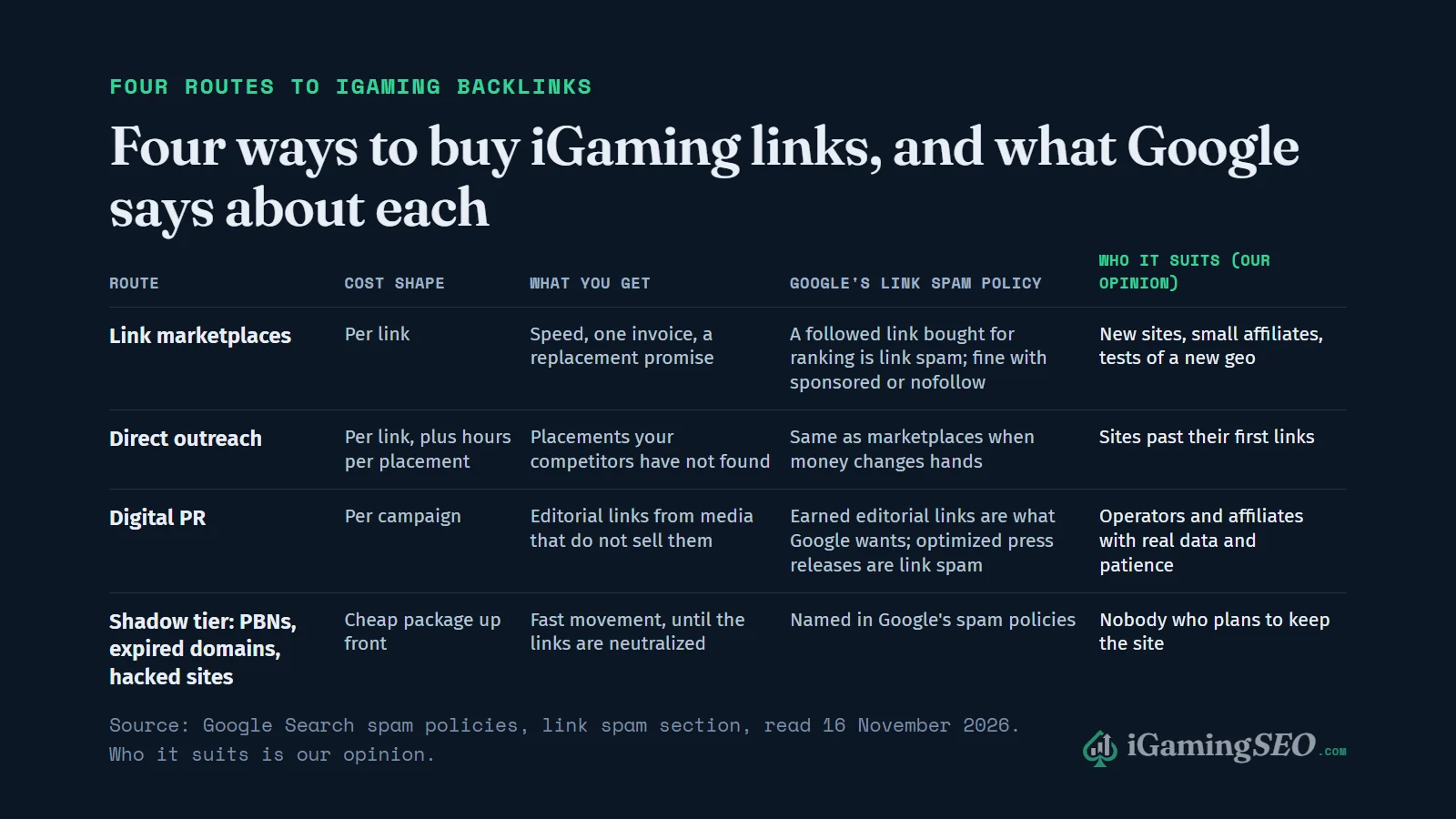
| Route | What you pay for | Cost shape | What you get | Google’s link spam policy | Who it suits |
|---|---|---|---|---|---|
| Link marketplaces | Access to publishers that accept casino content | Per link | Speed, one invoice, a replacement promise, a geo filter | A followed link bought for ranking is link spam; within policy only with rel=”sponsored” or rel=”nofollow” | New sites, small affiliates, tests of a new geo |
| Direct outreach | Time, plus the publisher’s fee | Per link plus hours per placement | Placements your competitors have not found | Same as marketplaces when money changes hands | Sites past their first links |
| Digital PR | A story or data, and the work to pitch it | Per campaign | Editorial links from media that do not sell them | Earned editorial links are what Google wants; press releases with optimized anchors are listed as link spam | Operators and affiliates with real data and patience |
| Shadow tier (PBNs, expired domains, hacked sites) | Links that fake the signals Google measures | Per package, cheap up front | Fast movement, until the links are neutralized | Named in Google’s spam policies | Nobody who plans to keep the site |
The next four sections take each row in turn.
Link marketplaces are fast, guaranteed and shared with your competitors
A link marketplace sells access to publishers who already accept casino content, at a listed price, usually with a promise to replace the link if it disappears.
That buys real things. You get speed, one invoice instead of forty, a guarantee and a filter by country. For a team with no outreach staff, that is worth paying for.
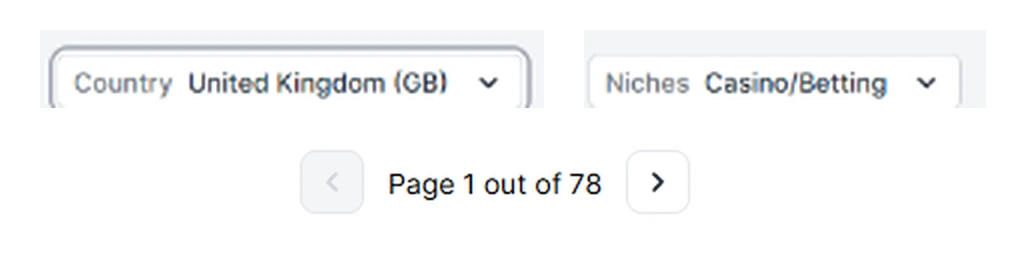
It does not buy a link your competitor cannot order tomorrow from the same list. Every casino affiliate in your geo can see the same inventory, so a marketplace link puts you level with the field at best. When I filtered one marketplace for UK sites that accept casino and betting content on 16 November, it listed 78 pages of 25 sites, more than 1,900 in all.
Then there is the margin. A marketplace sits between you and the publisher, and it charges for that. I wrote about the numbers in why iGaming SEOs are going back to manual link outreach, so I will not repeat them here.
A marketplace is the right tool for a new site laying its first links, for a small affiliate without outreach time, and for testing a new geo before you invest in it. You can find the link marketplaces in the directory.
Manual outreach is slower, cheaper per link and yours alone
Direct outreach costs time instead of a middleman’s margin, and it gets you links on sites your competitors have not found.
The manual outreach post covers why more iGaming SEOs are going this way and what to negotiate once a publisher says yes. In short, cutting out the middleman lowers the price per link, and a direct relationship gets you terms a marketplace never offers.
That post left out two things. The first is the cost of the outreach itself. Someone has to find the sites, write the emails and chase the replies, and those hours cost money whether you pay a freelancer or a salary. In one October 2026 campaign, in another niche that publishers price like casino, we contacted 188 sites with 278 emails. Of those, 70 replied with a price, a 37% reply rate, and 6 emails bounced. The client approved part of the list, so we ordered 14 placements. 9 went live, 2 of them guest posts and 7 link insertions, and the other 5 fell through and were replaced. Each live placement came to about $245 all in, between $185 and $280, with the site’s price included. We don’t track hours per placement, and prices are often higher than in that campaign.
The second is that outreach in this niche is still buying. Most casino publishers who reply quote a price. You skip the middleman, not the payment.
Outreach suits sites past their first links that need placements nobody else has. If your competitors buy from the same marketplaces you do, outreach is how you get ahead of them.
Digital PR gets links you cannot buy, at a cost you cannot predict
PR earns links from media that do not sell them. It only works when the brand has data or a story that a journalist wants.
I covered the process in how PR turns into links in iGaming. The short version is that you need something new to say, the right journalists, and patience, because a lot of coverage comes without a followed link.
Do not confuse PR with press release distribution. Google’s spam policies list “links with optimized anchor text in articles, guest posts, or press releases distributed on other sites” as link spam. A wire release with a casino anchor in it is a paid link with extra steps.
One data study we pitched went out in three outreach rounds, to 1,860 journalists in 5,177 emails, and got about 28 replies, 1.5%. Ahrefs now shows 31 domains linking to the study, 26 of them with followed links and 9 with a Domain Rating of 50 or more. About 20 of those links are automatic copies of one article on a single large site. That was a good campaign, and not every one goes that well. Paid outreach to publishers drew a 37% reply rate in the campaign above. Pitching journalists drew 1.5%.
PR suits operators and affiliates with real data, a budget and time to wait. It does not suit a new affiliate with nothing to say yet. The cost per link is unknown until the campaign ends, which makes it hard to plan around and hard to sell to a finance team.
PBN links, expired domains and hacked sites make up the shadow tier
This tier is cheap and fast because it fakes the signals Google measures. Google’s policies name every part of it.
A private blog network (PBN) is a group of sites one owner runs only to link out to the sites that pay. Expired domains are old domains bought for the links they already have, then filled with new content or pointed at a money site. Hacked or abandoned sites get links injected without the owner’s knowledge.
Google uses a casino example for this. When it announced its expired domain abuse policy in March 2024, it described someone who “might purchase a domain previously used by a medical site and repurpose that to host low quality casino-related content.” And since December 2022, Google says its SpamBrain system “can now detect both sites buying links, and sites used for the purpose of passing outgoing links.”
Search for casino links and look at what comes up. When I searched “buy casino backlinks” from the US on 16 November, six of the nine results on page one were link sellers’ service pages. One of them listed PBN links next to guest posts and niche edits, and another quoted about $194 per link. The other three were a forum question and two buyer’s guides. That tells you who sells at the bottom of this market.
Google keeps shipping updates aimed at this. The fourth spam update of 2026 landed in September. A neutralized link passes nothing, so a cheap package can mean paying for zero.
What link building costs, route by route
Marketplaces and direct deals charge per link. Outreach adds labor per placement on top. PR charges per campaign, with an unknown number of links at the end. The shadow tier charges little up front and returns nothing once its links are neutralized.
Price depends on the publisher’s real traffic, the geo and whether the site accepts casino content at all.
Which link building route fits your site
The right route depends on the site’s stage more than on its budget. This is my opinion, from running link budgets for iGaming clients, not a tested rule.
A new affiliate site
Foundation first. A new site needs indexable content and a clean technical base before links do much. Then a few placements in its own geo, from a marketplace or direct deals. Nothing from the shadow tier.
People will tell you how many links a month is safe for a new casino site. Nobody has published a tested number, and I will not make one up. We are testing it in the public SEO experiments.
An established affiliate
Move budget toward direct outreach, for links your competitors cannot copy. Keep marketplaces for filling gaps, such as a new geo or a page that needs a quick push. Test PR if the site has data of its own, such as player surveys, bonus tracking or odds history.
Anchor text gets more important once a site has a real link profile.
An operator brand
PR and partnerships first. Operators have news, data and sponsorships that affiliates lack, and journalists cover licensed brands. A licensed brand also has more to lose from a bad placement than an affiliate does, so the shadow tier is out, and marketplace links need a hard look before you buy.
What our own spam backlinks say about link metrics
Referring domain counts and authority scores count junk nobody paid for. So when a seller shows you big numbers for a site, part of those numbers can be junk too.
As I write this, Ahrefs shows 1,306 live referring domains pointing at igamingseo.com, and it flags 1,300 of them as spam. 961 of those send only nofollow links. Most of the other 339 are throwaway “domain authority checker” sites on .shop, .site and .store addresses. We took over this domain in October 2026, and we did not buy any of them.
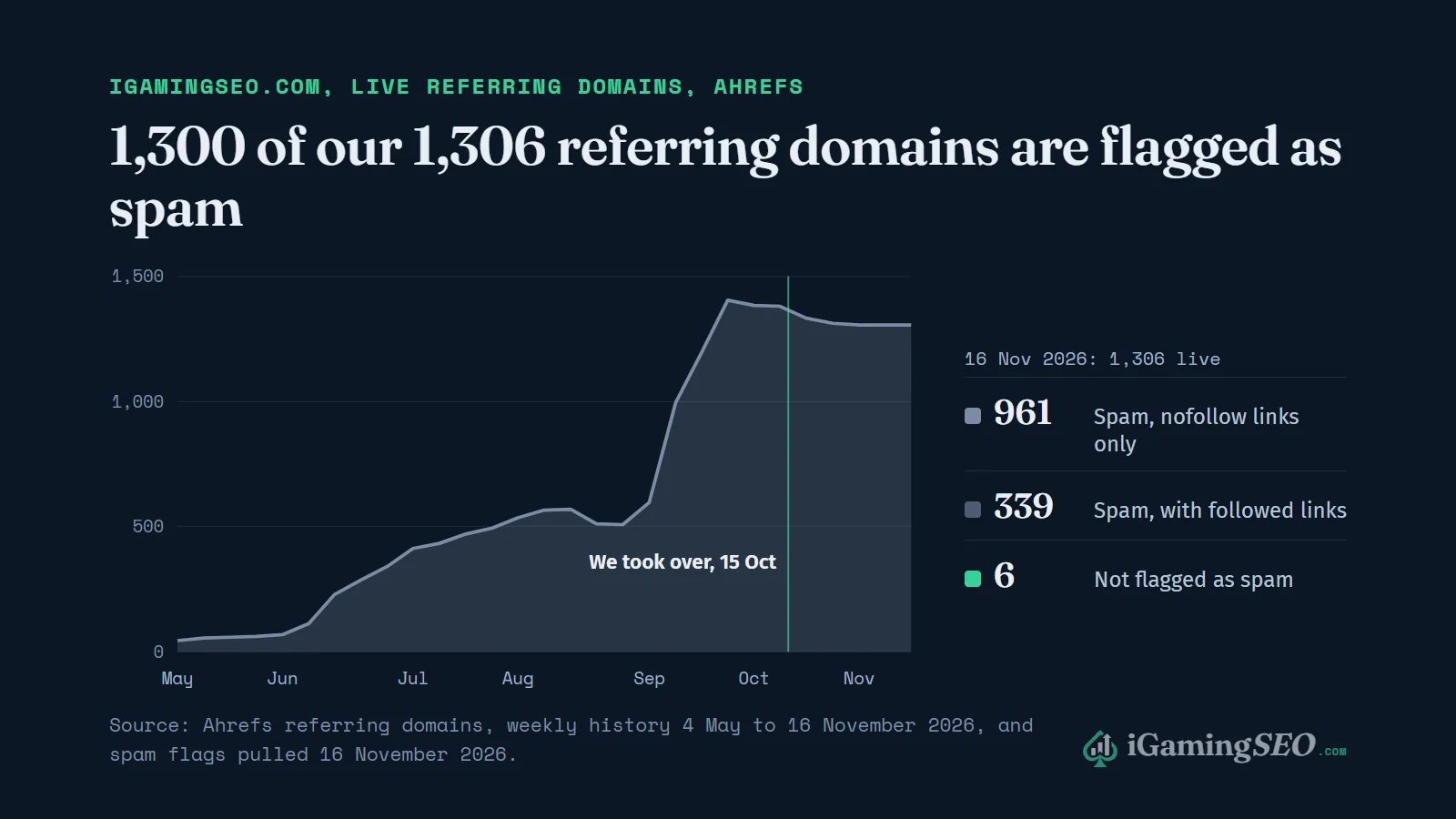
That inflates this site’s numbers in every third-party tool. The same thing happens to sites sold as link placements. A publisher can carry thousands of junk referring domains and a high authority score that has little to do with what Google trusts. It is one more reason third-party traffic numbers mislead.
What does Google say to do about junk links? In most cases, nothing. Its disavow help page says “most sites will not need to use this tool”, because Google can usually work out which links to trust. The tool is for sites with a manual action for unnatural links, or a likely one.
Link velocity and anchor text: what I will not guess
There is no published, tested safe number for links per month in iGaming. There is no tested safe share of exact-match anchor text either. Pages that give you one do not show their data.
We are testing both in public. Until those posts are live, you can follow them on the experiments page.
FAQ
Is buying links against Google’s rules?
Yes, when the link is meant to pass ranking credit. Google lists “buying or selling links for ranking purposes” as link spam. A paid link is within Google’s policy when it carries rel=”sponsored” or rel=”nofollow”. If Google catches a paid followed link, the result can be anything from the link being ignored to a manual action against the site.
How much does iGaming link building cost?
Marketplaces and direct deals charge per link, outreach adds hours per placement, and PR charges per campaign. The price of a single link depends on the publisher’s real traffic, the geo and whether it accepts casino content at all.
Do PBN links still work for casino sites?
Google’s policies name private networks, expired domains and hacked placements, and Google says its SpamBrain system detects both sites buying links and sites passing them. A neutralized link passes nothing, so a cheap PBN package often means paying for zero.
Can you build links to a gambling site without paying?
Yes, through PR with real data, original research and relationships with editors. It is slow, and it only works when you have something worth citing. See how PR turns into links in iGaming.
What is the best link building strategy for a new casino affiliate?
Foundation first, then a few relevant placements in the site’s own geo, and nothing from the shadow tier. Do not chase a fixed number of links per month, because nobody has tested one in public. The section on which route fits your site has more.
I run HIREQUARTERS, an SEO agency that builds links for iGaming clients and buys from some of the channels described here.
Where this comes from
5 sources from 1 publisher
Links as read on November 16, 2026.
 Google 5