Bulgaria licensed affiliates in August. Its ad ban bill would end them in January

Three bills, one committee vote, and an affiliate license that may last five months. What Bulgaria's ad ban plans mean for search, with our own top-10 sample.
By Milan Novaković 6 min read
Bulgaria started licensing gambling affiliates on 1 August. On 12 November, a parliamentary committee backed three bills that would ban almost all gambling advertising, and the government’s version would end those affiliate licenses on 1 January 2027. Nothing is law yet. On 15 November I checked who ranks in Bulgaria’s casino searches. Affiliates hold more of the top 10 than the casinos do.
What the committee passed
The National Assembly’s Budget and Finance Committee approved all three bills amending the Gambling Act at first reading on 12 November, 21 votes to none, after about three hours of debate. One bill comes from the government, which approved it and sent it to parliament on 11 November. The other two come from the opposition: We Continue the Change, filed on 4 September, and Democratic Bulgaria, filed on 9 September.
The next step is a first reading in the full chamber, and I found no date for it. The committee chair, Konstantin Prodanov, set up a working group to rewrite the disputed parts and said the changes must pass before the 2027 State Budget Act.
What the bills would ban
The government’s draft turns Article 10 of the Gambling Act into a general ban on advertising gambling, gambling companies and their brands, whatever the form, method or place. The only website exception is the operator’s own site, limited to what a player needs to take part. The draft has no exception for third-party review, comparison or information content. Sports sponsorship stays, with the registered trademark only. The draft also lets the National Revenue Agency (NRA) order the blocking of websites, apps, social media profiles and video channels that advertise gambling. Fines would run from EUR 10,000 to 20,000 for a person and EUR 20,000 to 50,000 for a company, doubled for repeat breaches. The government’s draft also raises what online betting operators pay: from 1 January 2027 the variable part of the license fee becomes 21% of gross gaming revenue, and at least EUR 100,000 a month per operator.
One caveat: I couldn’t get the bill as filed on 11 November, so the wording above comes from the finance ministry’s consultation draft of 23 September. The November press coverage matches its main points.
The two opposition bills go in the same direction. The We Continue the Change bill also covers content that isn’t formally advertising but promotes gambling, and the intermediaries and third parties used to get around the ban, with fines of EUR 75,000 to 150,000. The Democratic Bulgaria bill adds a clause aimed straight at search. Very large online search engines, as the EU’s Digital Services Act defines them, would be barred from showing the websites of operators without a Bulgarian license in their results.
Affiliates were licensed five months ago
Since 1 August 2026, promoting gambling for a commission tied to results is a licensed activity in Bulgaria. The license costs EUR 6,000 a year plus 10% of the commission, and a licensed affiliate may promote only operators with an active Bulgarian license. Sega reported on 13 November that 99 licenses had been issued and the fee paid on 79.
The government’s draft ends every one of them on 1 January 2027. The finance ministry’s impact assessment says a full ad ban requires it, names search engines among the places where gambling ads blend into content, and lists the closure of affiliate businesses as the bill’s main downside.
Then the ministry’s own deputy changed course in committee. Deputy Finance Minister Lyudmila Petkova proposed dropping the affiliate ban and allowing online gambling ads only through licensed affiliates that the NRA supervises. Her argument, as BTA reported it, is that without affiliates illegal operators would fill the online ad space. According to Sega, she put the illegal share of the market at 40%. Sega also reports that the online ad ban itself will most likely be dropped before second reading, because enforcing it is almost technically impossible. So the outcome for affiliates is open, from closing on 1 January to becoming the only legal online channel.
Who ranks in Bulgaria’s casino searches
I pulled the live Google top 10 for 20 Bulgarian casino and betting searches on 15 November, from “казино” and “онлайн казино” to “залози” and “прогнози за футбол”, and sorted every result by what its title and description say it is.
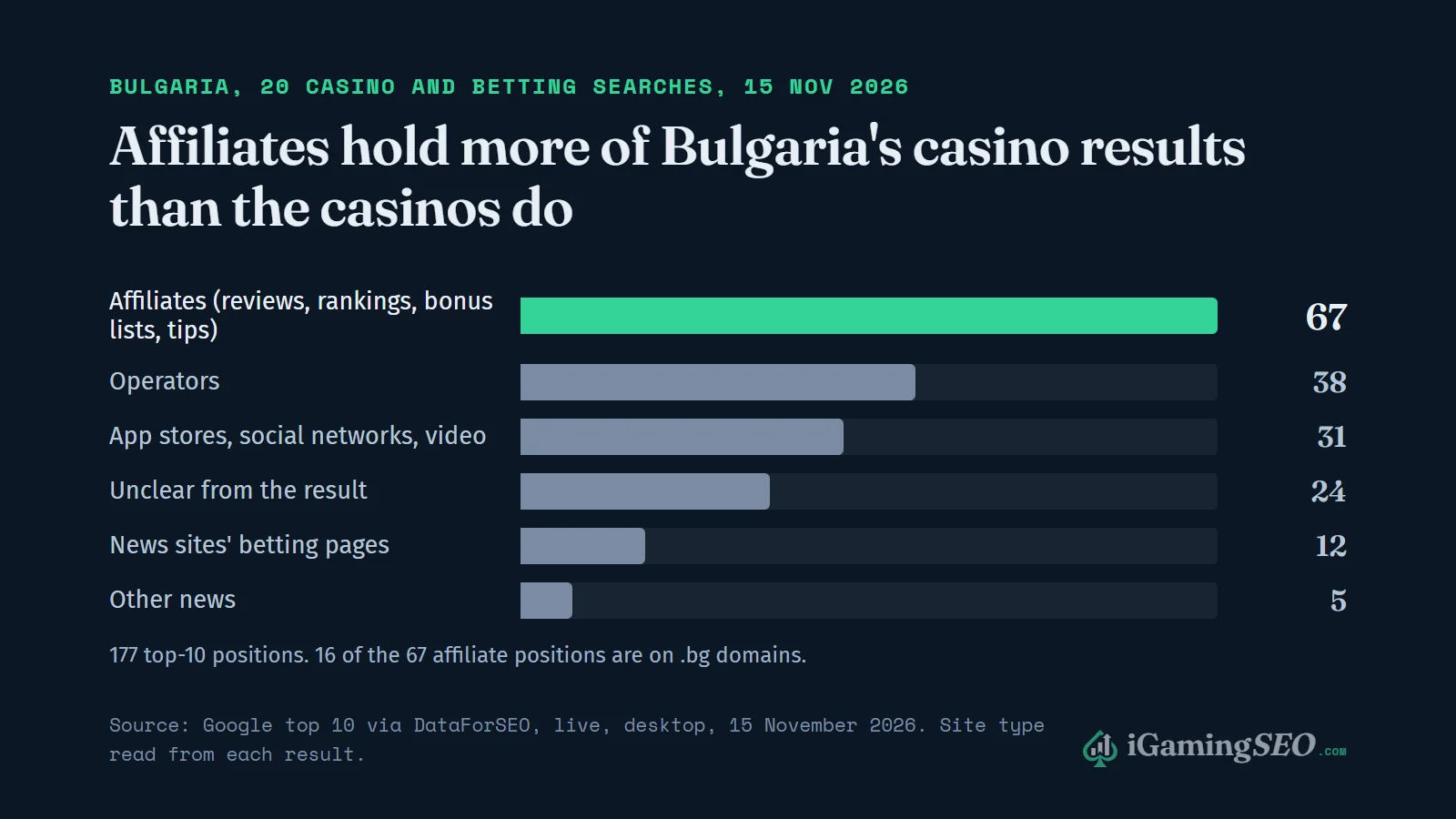
Affiliates, meaning review sites, rankings, bonus lists and tipsters, held 67 of the 177 positions and ranked first in 8 of the 20 searches. Operators held 38. App stores, social networks and video took 31, and betting pages on news sites took 12. The demand behind those searches is not small. Ahrefs puts “казино” at about 47,000 searches a month in Bulgaria, “онлайн казино” at 15,000 and “бонус без депозит” at 5,700.
The number that matters for the bill is where those affiliates sit. Only 16 of the 67 affiliate positions were on .bg domains. Of the 113 different sites in the sample, 38 were on .bg and 75 on other domains. A domain outside .bg can still belong to a Bulgarian company, so that isn’t a clean split between local and foreign. But for a site run from abroad, Bulgarian law has one tool, blocking, and the NRA already uses it. Since 1 August, internet providers must block the sites it names within 24 hours.
A commenter in the public consultation made the same point in September. Most affiliate sites live on organic search, and removing the licensed Bulgarian ones would hand those results to sites outside Bulgarian rules. That is a stakeholder’s opinion, not an official one. But it is close to Petkova’s argument, and our sample doesn’t contradict it.
One caveat. This is one live check of 20 searches, and the site types come from what each result says about itself, not from a license register. Another 24 results were too thin to classify.
What it means for SEO people in Bulgaria
- Licensed affiliates. The range runs from closing on 1 January to being the only legal online channel. Nothing is decided until second reading, so plan for both and watch the working group.
- The search clause. If the Democratic Bulgaria clause survives, Google would have to keep unlicensed operators out of its Bulgarian results. Our sample would look very different under that rule.
- Enforcement. Doubts came from inside the hearing. A digital media executive warned that Bulgaria would have to block YouTube, Facebook and TikTok, an employers’ group said national laws can’t regulate people based abroad, and an opposition MP said an online ad ban can only work at EU level.
- The current rules still apply. Today’s Article 10 already restricts gambling ads, including in electronic media and on websites, and a licensed affiliate may promote only Bulgarian-licensed operators. A pending bill changes none of that.
Brazil is the closest preview of the hard version. When it took out its licensed operators, Google filled the results with whoever was left, and that included pages on government servers.
My take
Bulgaria built a license for affiliates in August and may take it away in January. That is the Brazil lesson in slow motion: a market’s rules are now an SEO risk of their own, and a five-year license can last five months. What makes Bulgaria different is that its own deputy finance minister made the search argument in committee, and our sample fits it: three in four affiliate positions already sit on domains outside .bg. I’ll check the same 20 searches again after the second reading.
This article reports Bulgarian bills and search data as of 15 November 2026. It is not legal advice, and it does not encourage anyone to gamble or to advertise gambling in Bulgaria.
Where this comes from
14 sources from 8 publishers
2 of them our own measurements. Links as read on November 16, 2026.
 strategy.bg 4
 iGamingSEO.com 2
- parliament.bg 2
 kik-info.com 2
 bta.bg
- +3 publishers
See the listHide the list
-
DataForSEO live Google top 10, Bulgaria, 20 casino and betting searches, 15 November 2026, 12:53 UTC
-
Ahrefs Keywords Explorer, Bulgaria, 15 November 2026