Google widens query fan-out. In our iGaming test, 18 of 20 AI Mode sources weren’t in the top 10

Google says its new Search model runs wider query fan-out. In our US casino and betting test, a top-10 ranking for the keyword almost never got a site into the AI Mode answer.
By Milan Novaković 4 min read
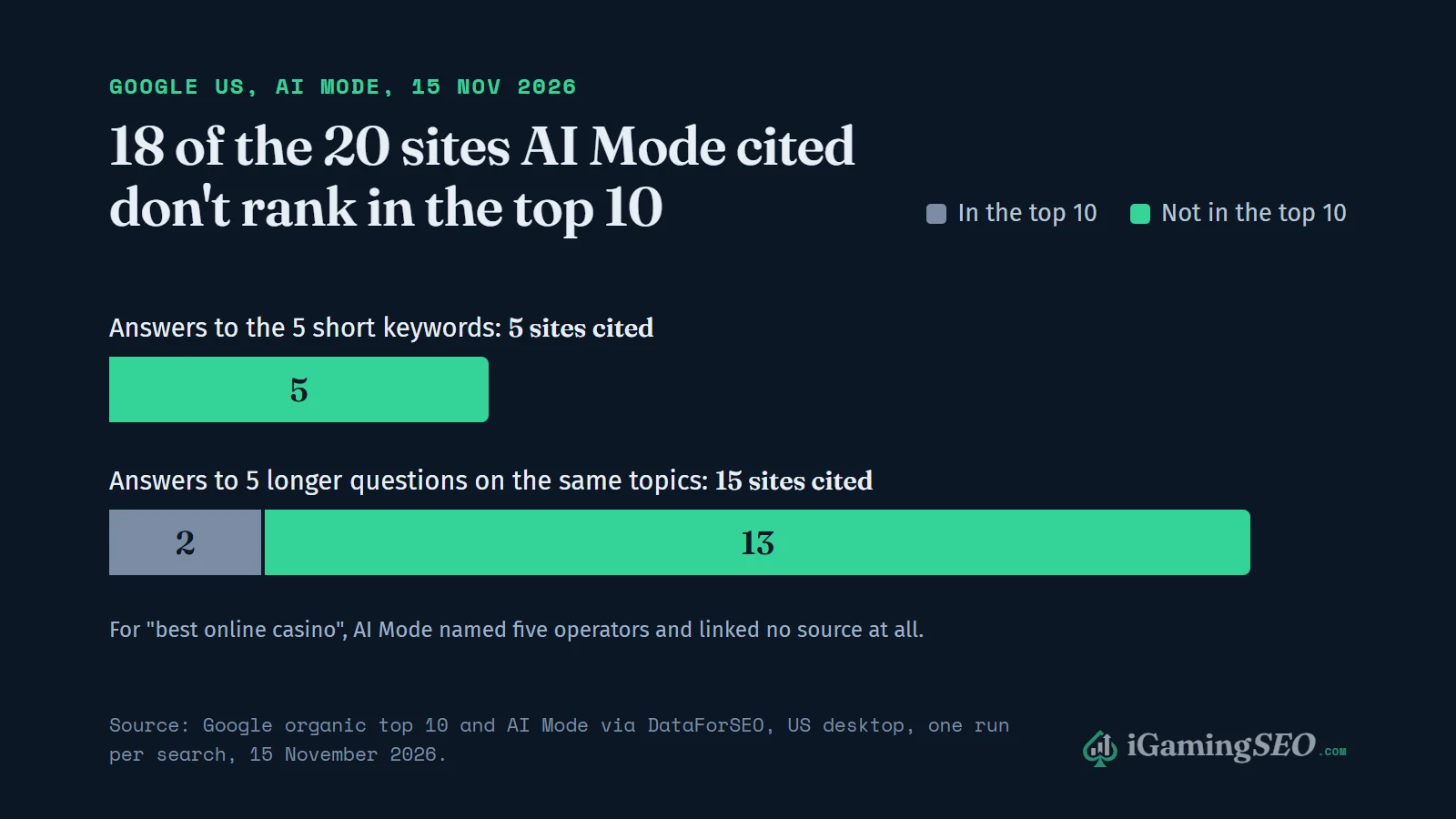
On 12 November Google started rolling out Gemini 4 Hydrogen in Search, for all users worldwide. Robby Stein, Google’s VP of Product for Search, wrote that the new model makes query fan-out stronger. Search runs simultaneous queries across all the relevant subtopics of a question and connects people to a broader range of sites than before. Google gave no numbers. The rollout also landed two days after Google started the November 2026 core update, so anything that moves in search this month has two possible causes. On 15 November I checked what AI Mode cites for US casino and betting questions. Of the 20 sites it linked in ten answers, 18 don’t rank in Google’s top 10 for the short keyword behind the question.
What query fan-out does
A person types one question. Google splits it into several searches, one for each part of the question, and builds the answer from what those searches return. Ask which legal online casino in New Jersey pays out fastest and has the lowest wagering on its welcome bonus, and Google searches separately for New Jersey licensing, withdrawal times and bonus terms. Each of those searches picks its own sources. By Google’s account, Hydrogen does this better and connects people to more sites.
What we measured
I picked five common US casino and betting topics. For each one I took a short keyword and a longer question a player might ask about the same thing. Through DataForSEO I pulled Google’s organic top 10 for the short keyword, then AI Mode’s answer for both the keyword and the question, all from a US desktop location between 21:52 and 21:55 UTC. Then I checked how many of the sites linked in each answer also rank in that top 10.
| Topic (short keyword) | Sites cited, keyword | In top 10 | Sites cited, longer question | In top 10 |
|---|---|---|---|---|
| best online casino | 0 | 0 | 2 | 0 |
| sports betting apps | 1 | 0 | 2 | 1 |
| online casino bonus | 1 | 0 | 1 | 1 |
| online poker sites | 2 | 0 | 8 | 0 |
| Two sportsbooks compared (brand keyword) | 1 | 0 | 2 | 0 |
| Total | 5 | 0 | 15 | 2 |
| Source: Google US desktop, organic top 10 and AI Mode, pulled through DataForSEO on 15 November 2026. “Sites cited” counts unique sites linked inside the AI Mode answer. “In top 10” counts those that also rank in the organic top 10 for the short keyword. | ||||
Four things stood out:
- The biggest keyword sent no one anywhere. For “best online casino”, AI Mode named five state-licensed operators and linked no source at all. None of the sites in the organic top 10 for that keyword got anything from the answer.
- Short keywords didn’t reward the top 10. Across the five short keywords, AI Mode linked five sites. None of them ranks in the top 10 for the keyword it answered.
- Longer questions spread wider. The five questions pulled 15 sites, three times as many. Two rank in the top 10 for the matching short keyword: a national sports outlet for betting apps, and a Philadelphia sports site for casino bonuses.
- A regulator showed up where the question needed one. The poker question asked which legal poker sites share player pools across New Jersey, Michigan and Pennsylvania. AI Mode cited eight sites, including the Pennsylvania Gaming Control Board, poker news sites and an industry trade site. None of the eight ranks in the top 10 for “online poker sites”.
This is one run per search, on one day, from one location. AI Mode answers change between runs, and DataForSEO records the links inside the answer, so Google’s page may show more around it. Read the numbers as a sample, not a rate.
What this means for iGaming sites
- The top 10 is not the answer. In our sample, a top-10 ranking for the short keyword got a site into the AI Mode answer twice in 20 citations.
- Each part of the question is its own search. The cited pages answered one part exactly: a state’s rules, a payout time, a bonus term, a shared player pool. Pages that state those facts per state, with dates, give each sub-search something to take.
- Official sources compete with you. When a question touched licensing, AI Mode went to the regulator. A page that cites the regulator and adds what the regulator doesn’t say has a reason to sit next to it in the answer.
My take
Short-tail and long-tail keywords are part of SEO’s history. Today search runs on queries and query fan-out, and we need to adapt to that. What makes the difference now is topic authority, entities and understanding the buyer’s intent, and AI models keep getting better at understanding all three. If AI understands your topic that well, your SEO and GEO strategy has to understand it at least as well. In our test, a top-10 ranking got a site into the answer in 2 of 20 cases. I’ll run the same ten searches again when the core update finishes.
This article reports Google search results as of 15 November 2026. It does not recommend any operator, and it does not encourage anyone to gamble.
Where this comes from
3 sources from 3 publishers
1 of them our own measurement. Links as read on November 16, 2026.
 iGamingSEO.com
 Google
 Search Engine Roundtable
-
DataForSEO, Google US desktop organic top 10 and AI Mode, 5 short keywords and 5 longer questions, 15 November 2026, 21:52 to 21:55 UTC