AI cited 60 pages for 12 casino searches. Only one was in Google’s top 10
AI Mode and ChatGPT cited 60 pages for 12 casino searches, and one was in Google's top 10. What 49 studies and our crawl of 162 pages say gets a page cited.
By Milan Novaković 11 min read
AI answers cite pages they can fetch, read and find in search, and in casino and betting searches they mostly cite brands they already know. On 17 November we ran 12 US and UK casino and betting searches through Google AI Mode and ChatGPT. The two cited 60 pages between them, and only one of those pages was in Google’s top 10 for the same search. On the page itself, four things have real evidence behind them: a short answer near the top, numbers with a source, tests of your own, and updates that change something. Schema, llms.txt and FAQ blocks have little or none.
I read 49 sources to get here: 6 research papers, about 28 industry studies and the platforms’ own documentation, from 2024 to November 2026. We did this research at HIREQUARTERS for our SEO and AI search work with iGaming clients, and we’re building a tool that checks a page against these factors. Below is what holds up for casino affiliates, what doesn’t, and what our own test added.
What we tested on 17 November
We picked 6 US and 6 UK searches, from “best online casinos” to “free bets”, and pulled three things for each through DataForSEO: Google’s organic top 10, the sources Google AI Mode linked, and the sources ChatGPT cited when it searched the web through OpenAI’s API. Then we loaded every page twice. The first load was a plain HTTP request that runs no JavaScript, which is how most AI crawlers read a page. The second was Chrome, with scripts on, scrolled to the bottom. Comparing the two shows what an AI crawler misses.
AI answers mostly skipped the Google top 10
Google AI Mode linked 20 pages across the 12 answers. One of them ranked in Google’s top 10 for the same search. ChatGPT cited 40 pages, and none of them did. It matches what we saw on 15 November, when 18 of the 20 sites AI Mode cited for US casino questions didn’t rank in the top 10 for the short keyword.
| Type of site | Google top 10 | Google AI Mode | ChatGPT |
|---|---|---|---|
| Newspapers and sports media | 15 | 6 | 8 |
| Gambling affiliates and betting media | 69 | 7 | 23 |
| Operators | 10 | 3 | 1 |
| Regulators and official bodies | 1 | 3 | 8 |
| Other sites, most of them unrelated to gambling | 11 | 1 | 0 |
| All | 106 | 20 | 40 |
| Pages per type for 12 US and UK casino and betting searches. Source: our test through DataForSEO, 17 November 2026. | |||
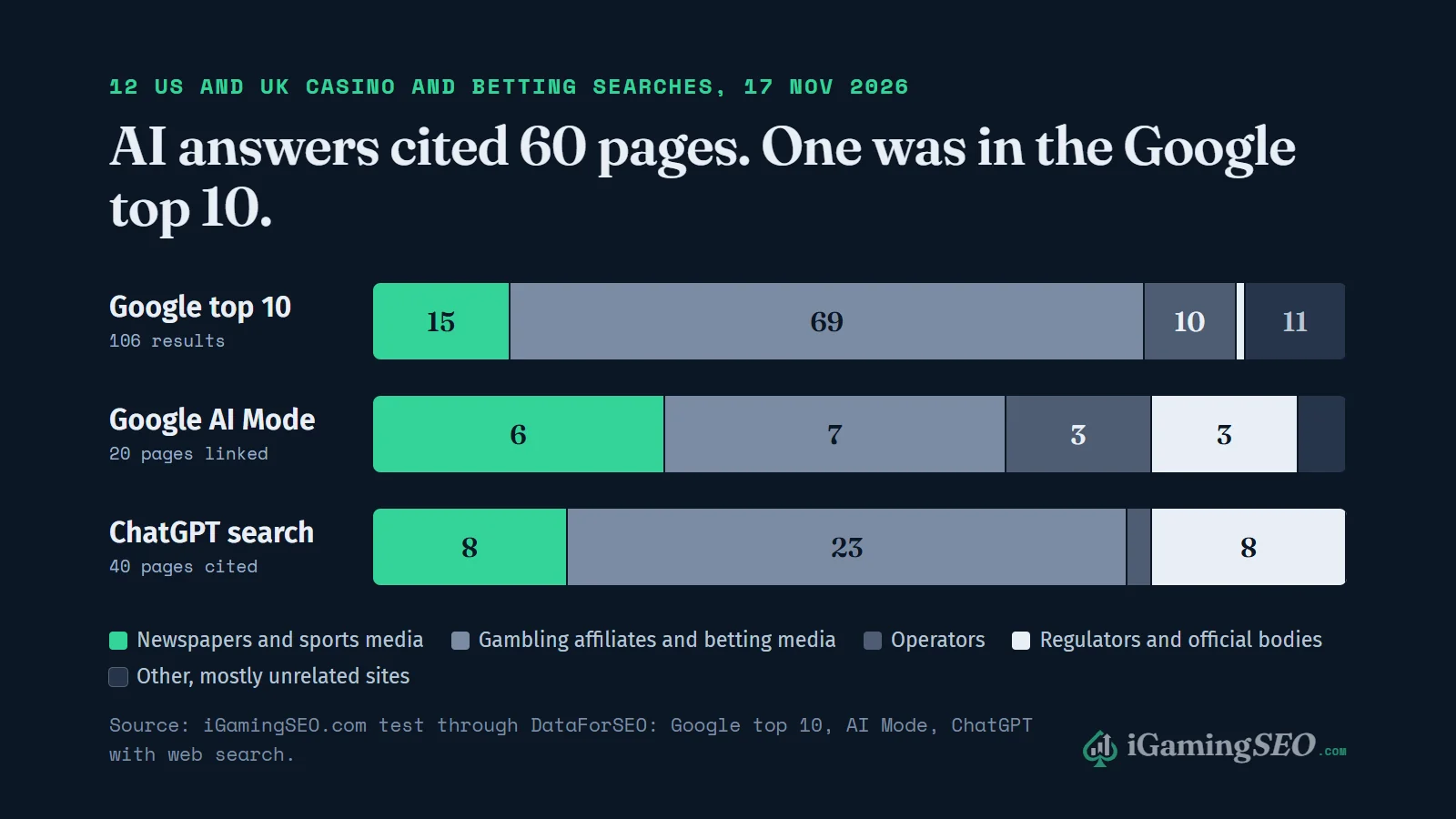
Both engines looked past Google’s ranking. AI Mode leaned on newspapers’ betting sections, sports media and the regulators. ChatGPT leaned on large betting media and comparison brands, and on the regulators for anything about what’s legal. The affiliate citations were concentrated, too. Google’s 69 affiliate results came from 57 different sites. ChatGPT’s 23 came from 10, all of them large betting media and comparison brands. Sites with nothing to do with gambling held 11 of Google’s 106 top-10 spots, and the AI answers cited one such page in 60.
ChatGPT also showed us how it searches. Behind the 12 answers it ran 61 searches, and 22 of them were limited to one named site with a site: search. Thirteen went to operators’ own sites, seven to US state government sites and two to comparison sites it named. For facts, it goes to the source. For comparisons, it goes to a few brands it already knows.
Retrieval comes first
Every study that measured it agrees on the order. A page has to be crawlable, indexed with a snippet allowed, readable without JavaScript and ranking somewhere for the question before anything on it matters.
- Search position decides most of it. In 815,484 query and page pairs that Kevin Indig analyzed with AirOps, a page’s position in ChatGPT’s own search results was the strongest predictor of a citation: 58% of pages at the top of those results were cited, against 14% at position 10.
- Rank beats on-page tricks. C-SEO Bench, a NeurIPS 2025 benchmark, found most conversational SEO methods did little or harm, while a page’s rank in the model’s context mattered far more.
- Blocked means absent. OpenAI says sites that block OAI-SearchBot aren’t shown in ChatGPT search answers. Google says a page must be indexed and eligible for a snippet to appear in AI Overviews and AI Mode.
- JavaScript is a wall for most AI crawlers. Vercel and MERJ found that none of the major AI crawlers, GPTBot, OAI-SearchBot and ClaudeBot among them, run JavaScript. Google does, so this mostly hits ChatGPT, Claude and Perplexity.
What a crawler without JavaScript gets from casino pages
We could load 131 of the 162 pages in Chrome. For 86 of them, about two in three, the plain request got the same page Chrome did. The other 45 gave a crawler that runs no JavaScript less than a reader sees, in four ways.
- A block page instead of the article. Nineteen pages answered the plain request with a 403, a bot challenge or an error, and served the full page to Chrome.
- Offers added by JavaScript. On 12 pages the toplist or most of the bonus terms appeared only after scripts ran.
- A shorter page. Nine pages lost a fifth or more of their text without JavaScript.
- An empty shell. Five pages were close to blank without JavaScript, two operators’ casino lobbies and three sports media pages.
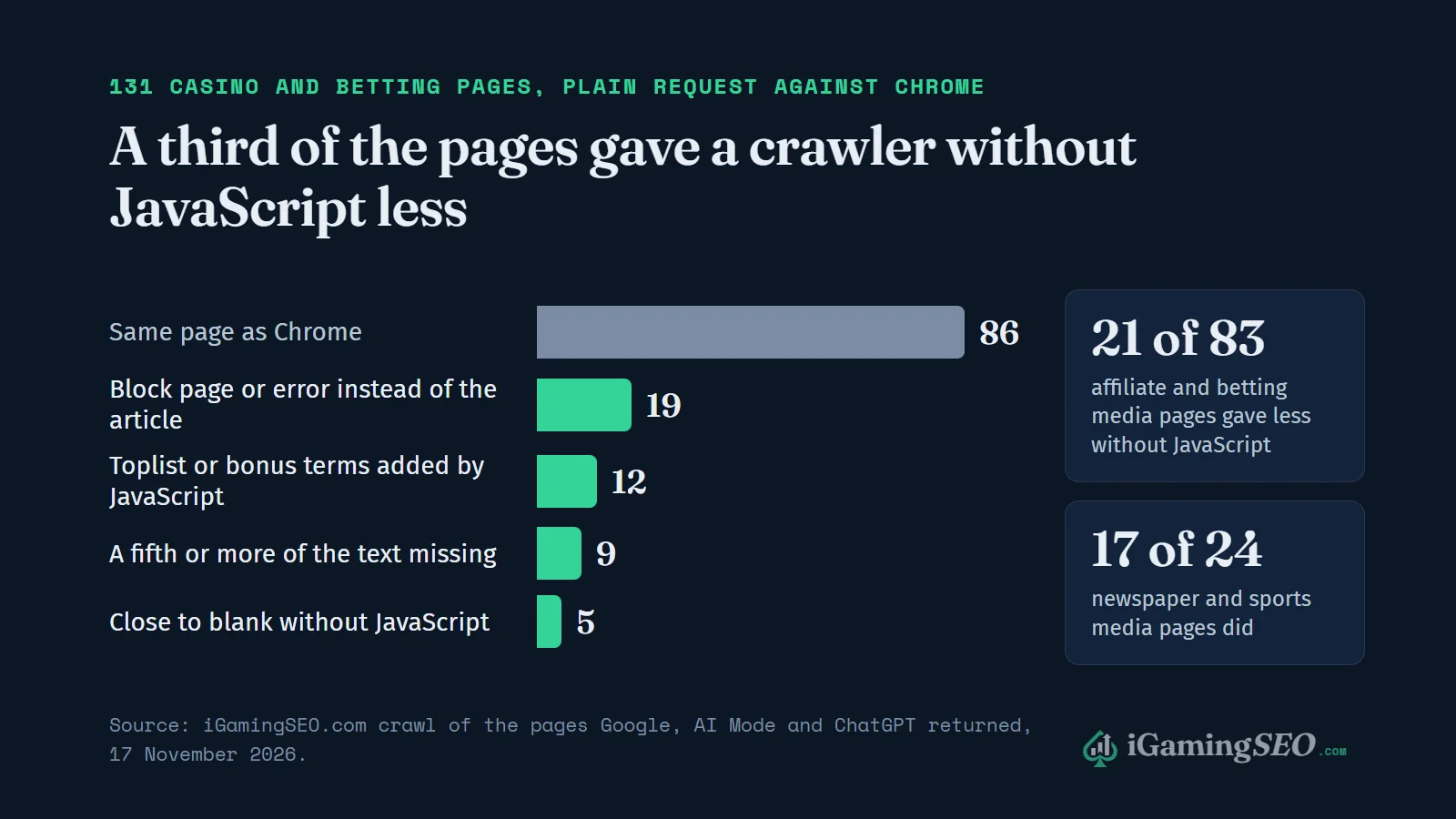
Affiliates came out better than their reputation. Of the 83 affiliate and betting media pages we could load, 62 gave the plain request the same page as Chrome, and most of the rest were block pages. Newspapers and sports media did worst: 17 of their 24 pages lost something, often a toplist that a script fills in. The worry I started with, author bylines that only appear after JavaScript runs, didn’t hold up. Of the 60 pages that showed an author’s name in Chrome, 59 had it in the raw HTML too. Update dates looked the same, 51 of 54.
robots.txt was rarely the problem. Of the 105 top-10 pages, one blocked OAI-SearchBot, the crawler behind ChatGPT search. Two blocked PerplexityBot and one blocked Claude-SearchBot. Seven blocked GPTBot and ClaudeBot, which collect training data and don’t decide what a search answer cites. We couldn’t read robots.txt on 13 of the sites.
One caution about the blocks. Our plain request isn’t OpenAI’s crawler. ChatGPT cited five pages that gave us a block page, so those sites let its crawler through or it read them from a search index. A block page for a plain request is a reason to check, not proof that AI can’t see you. Look in your server or CDN logs for OAI-SearchBot, ChatGPT-User, PerplexityBot and Claude-SearchBot, and at the status codes they got.
Bots aren’t the only gatekeepers. Bitdefender, the antivirus on the machine we ran the crawl from, blocked one page as suspicious: a casino page on a site that has nothing to do with gambling. Antivirus software doesn’t decide what AI cites, but it can stop the people an AI answer sends you from ever reaching the page.
Brand mentions and fan-out rankings beat page tweaks
Once a page can be fetched, the strongest signals sit off the page.
- Mentions across the web. In Ahrefs’ study of 75,000 brands, YouTube mentions correlated with AI visibility at about 0.737 and branded web mentions at 0.66 to 0.71. Backlinks came in at 0.218 and Domain Rating at 0.27 to 0.33.
- Rankings for the follow-up questions. Surfer found a 0.77 correlation between how many fan-out queries a page ranks for and its chance of an AI Overview citation.
- Lists of the best. “Best X” lists made up 43.8% of the pages ChatGPT cited across 750 recommendation prompts.
- A few affiliates take most of it. In a 2026 report on 100 iGaming prompts and 146 affiliate brands, the top three affiliates took 37% of 1,755 citations. We read it through the trade-press summary.
Our test fits this. The cited pages came from brands the engines know, and ChatGPT searched some of them by name. For an affiliate, being named in the pages AI already cites for your money terms is a goal you can measure, and it’s mostly a PR job, not an on-page one. Our iGaming SEO guide for 2026 on HIREQUARTERS covers how a brand gets recognized by Google and by AI.
The page features with real evidence
- A short answer near the top. Indig’s analysis of 18,012 ChatGPT citations found 44.2% came from the first 30% of a page and 24.7% from the last third. Adam Gnuse found that 72.4% of cited posts had a short answer right after the title or a question heading, on a smaller sample of 15 enterprise domains. No study tested intro length on its own, so the answer’s position matters, not the word count before it.
- Numbers, quotes and sources. The one controlled page experiment, the GEO paper from KDD 2024, found that adding quotations raised visibility by 40.9%, statistics by 30.6% and cited sources by 27.5%. SE Ranking found pages with 19 or more data points averaged 5.4 ChatGPT citations, against 2.8 for pages with few.
- Tests of your own. Gnuse found original data or a proprietary insight on 52.2% of the blog posts ChatGPT cited. Google’s review guidance asks for first-hand evidence and measurements, which for a casino page means a deposit you made, a withdrawal you timed and a bonus you cleared.
- Updates that change something. Seer Interactive found 72% of cited pages were updated within a year but only 42% were published within a year. SE Ranking saw 6.0 average citations for pages updated in the last three months, against 3.6 for older ones. Google warns against changing the date without changing the page.
- Headings that match the question. In the AirOps data, pages whose headings closely matched the question (a similarity of 0.90 or more) were cited 41% of the time, against 30% below 0.50. Word count, heading count and readability looked the same for pages that were always cited and pages that never were.
Tone isn’t the problem many people think it is. Semrush compared 304,805 AI-cited URLs with Google’s top 20 and found the cited pages more persuasive, 26.19% lower on its non-promotional tone score. What hurts is a claim with nothing behind it. “The best casino of 2026” with no number, test or source gives an AI engine nothing to repeat.
The popular fixes with little or no evidence
- Schema. Ahrefs tracked 1,885 pages that added JSON-LD against matched pages that didn’t. Citations barely moved: up 2.4% in AI Mode and 2.2% in ChatGPT, down 4.6% in AI Overviews, none of it significant. Keep schema for rich results and clean data, not for citations.
- llms.txt. SE Ranking found a negligible effect, and Google says no special AI text files are needed.
- FAQ blocks and question headings. The data conflicts. SE Ranking saw 3.8 average citations for pages with FAQ sections against 4.1 without, and 3.4 for question-style titles against 4.3 for plain ones. Indig found text with a question mark cited 18% of the time against 8.9% without.
- Tables. A 2,400-test experiment by 5WPR found the format moved correct-answer rates by 1.1 points.
- Length. SE Ranking and an earlier Indig study favor long pages. The larger AirOps data found always-cited and never-cited pages both averaged about 2,200 words.
Keep bonus terms, licenses and safer gambling notices, but not for AI
No study we found tested offer accuracy, license details or responsible gambling notices against AI citations. They belong on a casino page for other reasons. In the UK, ASA and CAP guidance says a bonus ad has to state its significant conditions clearly, and Google’s review guidance asks you to show the evidence behind a ranking. Treat them as compliance and trust work, and don’t sell them to a client as an AI lever. This isn’t legal advice.
What I would fix first on a casino page
- Check robots.txt and your CDN’s bot settings for the AI search crawlers: OAI-SearchBot, ChatGPT-User, PerplexityBot and Claude-SearchBot. A firewall rule written for scrapers can stop them too. Then request your top 20 money pages without JavaScript and read what comes back: the toplist, the terms next to each offer, the author and the date.
- Check your domain in Google’s Safe Browsing site status and in VirusTotal, which asks dozens of security vendors at once. If one of them flags you, ask that vendor for a review.
- Put a one to three sentence answer under the H1, with a number in it.
- Tie every claim to a number, a test or a source, and run one test of your own per page.
- Update the page for real when the offers change, and show the date.
- Get named in the pages AI already cites for your money terms. In our test those were media betting sections, large comparison brands and regulators, not the Google top 10.
How we tested, and the limits
We ran the 12 searches on 17 November 2026 through DataForSEO: Google desktop organic results and Google AI Mode in English for the US and the UK, and ChatGPT through OpenAI’s API (model gpt-5.4-mini with web search, searching from the US or the UK). The API isn’t the ChatGPT app, and one run of each answer is a sample, since AI answers change from run to run. We loaded 162 unique pages twice: once as a plain HTTP request with a desktop browser’s user agent, and once in Chrome with scripts on, scrolled to the bottom. In both copies we counted words, bonus terms (match percentages, free spins, wagering multiples, money amounts tied to a bonus, bonus codes), affiliate links, author names and update dates. A page counted as missing offers when Chrome showed at least five bonus terms or affiliate links and the plain copy had fewer than half as many. Another 31 pages wouldn’t load either way, so they’re left out of the counts. Ten of them came back as our internet provider’s gambling block page, because we ran the crawl from Serbia. The rest hit bot walls, rate limits, a broken certificate or the antivirus block above. We read robots.txt with Google’s matching rules for 11 crawlers, and we sorted the sites into types by hand. We name none of them.
Most of the 49 sources are correlational and come from companies that sell AI visibility tools. Pages that rank, belong to strong brands and get maintained tend to have many of these features at once, so a number for one feature doesn’t isolate its effect. Where we couldn’t open the primary source, as with the Gnuse study and the iGaming affiliate report, we read a summary.
My take
Most of what’s being sold as AI optimization is schema, llms.txt and FAQ blocks, and that’s where the evidence is thinnest. In casino search the picture is plainer: AI answers go to brands they already know and to pages they can read, so the work is SEO and PR done for a reader that runs no JavaScript. We’ll run the same 12 searches again in December and publish what changed.
Where this comes from
23 sources from 16 publishers
1 of them our own measurement. Links as read on November 19, 2026.
 searchenginejournal.com 3
 Google 3
 Ahrefs 3
 arxiv.org 2
 iGamingSEO.com
- +11 publishers
See the listHide the list
-
Our test: 12 US and UK casino and betting searches, 17 November 2026